Publications
Sakura Finetek USA, as leading healthcare organizations in the field of pathology, faces quickly evolving challenges in laboratories, like workplace and workflow changes, technology transformation, automation and productivity, and the growing importance of digital media, which all are shifting customer expectations while shaping the experience of laboratory personnel.
We understand that delivering our products and services in partnership with our customers requires engagement with laboratory personnel on all levels. This webpage is intended to reflect several aspects of the experience we can provide to our customers using the best pathology, histology and cytology equipment. Our products deliver the best in-class patient care, great workplace quality of life, excellent quality of results and fast turnaround time.
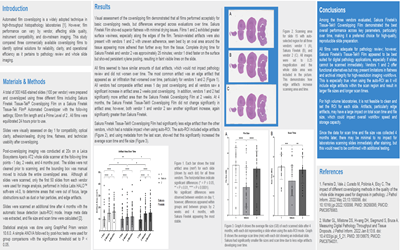
Comparative Evaluation of Automated Coverslipping Film from Multiple Vendors
Automated film coverslipping is a widely adopted technique in high-throughput histopathology laboratories [1]. However, film performance can vary by vendor, affecting slide quality, instrument compatibility, and downstream imaging …
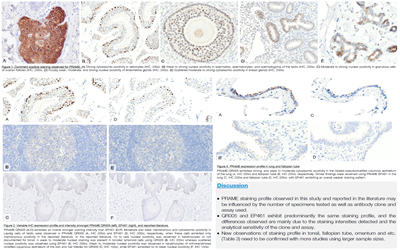
Immunohistochemical Expression Profiles of PRAME in Human Normal FFPE Tissue Spe…
PRAME (PReferentially expressed Antigen in Melanoma), is a member of the Cancer Testis Antigen (CTA) gene family, which has been detected in various tumors by Northern Blot, RT-PCR, and IHC. PRAME is commonly used as …
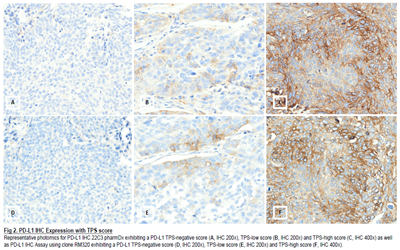
Comparative Analysis of a New IHC Assay for PD-L1 Expression in Non-Small Cell L…
Lung cancer is one of the leading causes of cancer-related mortalities globally and especially the United States. The level of Program Death Ligand-1 (PD-L1) IHC expression is used …
Automated Robust Image Analysis Qualifying H&E Staining Adequacy with Varying Hematoxylin and Eosin Incubation Times
Inconsistencies in H&E staining protocols are a well recognized feature across different histopathology laboratories. The aim of the study was to validate an automated image analysis system (IAS) to qualify H&E staining adequacy with varyi
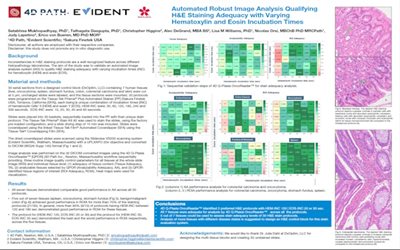
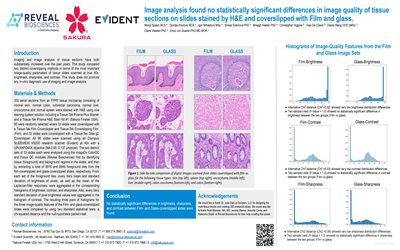
Image analysis found no statistically significant differences in image quality of tissue sections on slides stained by H&E and coverslipped with Film and glass.
No statistically significant differences in brightness, sharpness, and contrast between Film- and Glass-coverslipped slides were found.
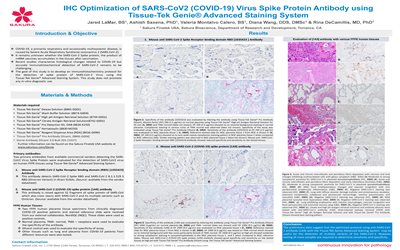
IHC Optimization of SARS-CoV2 (COVID-19) Virus Spike Protein Antibody using Tissue-Tek Genie® Advanced Staining System
The preliminary data suggest that the optimized protocol using anti-SARS-CoV-2 antibody [1A9] with the Tissue-Tek Genie Advanced Staining System may be useful for the detection of multiple variants of the SARS-CoV-2. However, testing of more sampl
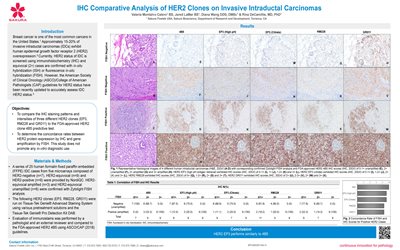
IHC Comparative Analysis of HER2 Clones on Invasive Intraductal Carcinomas
HER2 EP3 performs similarly to 4B5
Anatomical Pathology Patient Interest Association (APPIA) TOPS Tissue Handling Guidelines illustrate an ongoing education initiative to improve the understanding of pre-analytical factors and promote standardization in tissue workflows.
The TOPS guidelines are separated into the ten (10) main sequential steps of the pre-analytical process and list the industry best practices related to each step. The ten primary steps include tissue specimen labeling, tissue specim
800,000 slides show Film helped to dramatically cut down on scanning errors
To prevent interference with the mechanical elements of the scanning system and unnecessarily increase scanning time, glass slides need to be clean and free of artifacts, and coverslips have to be placed carefully, well-aligned and free of excess
Unlocking the mystery of an effective tissue processing protocol
Having an efficient tissue processing protocol is crucial for multiple reasons. With its upstream positioning in the histology process, inefficient tissue processing can have negative ramifications through the rest of the downstream process from e
Evaluation of two eco-friendly neutralizers for a spectrum of tissue fixatives for biomedical applications
Formaldehyde is a widely used aldehyde in biomedical applications, including tissue fixation. It is this same fixative property that can result in toxicity if aldehydes are improperly discarded. A proper neutralization of aldehyde waste products c
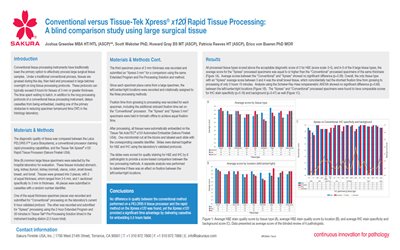
Conventional versus Tissue-Tek Xpress® x120 Rapid Tissue Processing
Conventional tissue processing instruments have traditionally been the primary option to effectively process large surgical tissue samples. Under a traditional conventional process, tissues are grossed during the day, then held and processed in la
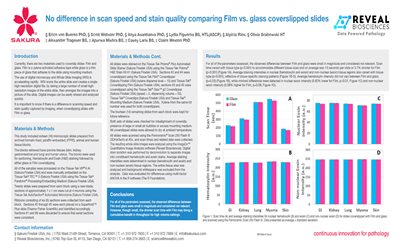
No difference in scan speed and stain quality comparing Film vs. glass coverslipped slides
It is important to know if there is a difference in scanning speed and stain quality captured by imaging, when coverslipping slides with Film or glass.
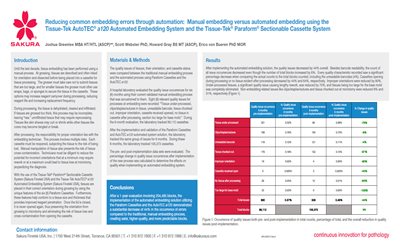
Reducing common embedding errors through automation: Manual embedding versus automated embedding using the Tissue-Tek AutoTEC® a120 Automated Embedding System and the Tissue-Tek® Paraform® Sectionable Cassette System
Until the last decade, tissue embedding has been performed using a manual process. At grossing, tissues are described and often inked for orientation and dissected before being placed into a cassette for tissue processing.
Use of Ozone for Inactivation of Bacteria and Viruses in Cryostats
In cryotomy, the risk of transmittance of health-care associated pathogens from tissue samples and surfaces is of particular concern. For optimal staff protection, it is often desirable to reduce the risk of contamination by a simple disinfection
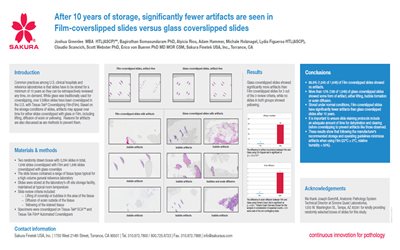
After 10 years of storage, significantly fewer artifacts are seen in Film-coverslipped slides versus glass coverslipped slides
Common practices among U.S. clinical hospitals and reference laboratories is that slides have to be stored for a minimum of 10 years so they can be retrospectively reviewed any time, on-demand. While glass was traditionally used for coverslipping,
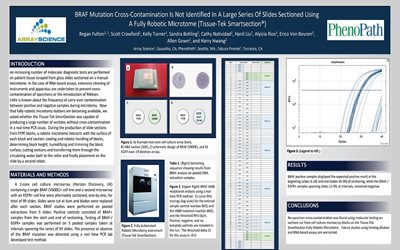
BRAF Mutation Cross-Contamination Is Not Identified In A Large Series Of Slides Sectioned Using A Fully Robotic Microtome (Tissue-Tek Smartsection®)
An increasing number of molecular diagnostic tests are performed on patient tissue scraped from glass slides sectioned on a manual microtome. In the case of RNA-based assays, extensive cleaning of instruments and apparatus are undertaken to preven
A Minimally Invasive Method (Liquid Biopsy) Enabling Detection of Rare Cells using Cell Enrichment and Immunohistochemistry
Whole blood, serving as a “liquid biopsy”, can provide a means of monitoring the status of a cellular or tissue-based event (e.g. cancer) using a minimally invasive needle stick of the patient.
Improving the Yield of Cell Deposition onto Glass Slides to Detect Target Cells
The cytocentrifugation protocol for depositing cells from a suspension onto glass slides requires maximal cell yield and highest recovery rate to detect target cells. These deposited cells need to retain their cellular integrity for cell or biomar
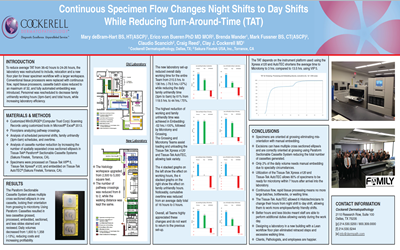
Continuous Specimen Flow Changes Night Shifts to Day Shifts While Reducing Turn-Around-Time (TAT)
To reduce average TAT from 36-42 hours to 24-26 hours, the laboratory was restructured to include, relocation and a new floor plan for linear specimen workflow with a larger workspace. Conventional tissue processors were replaced with continuous f
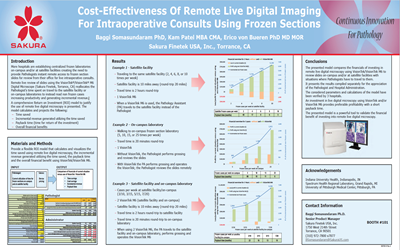
Cost-Effectiveness Of Remote Live Digital Imaging For Intraoperative Consults Using Frozen Sections
More hospitals are establishing centralized frozen laboratories on-campus and/or at satellite facilities creating the need to provide Pathologists instant remote access to frozen section slides for review from their office for live intraoperative
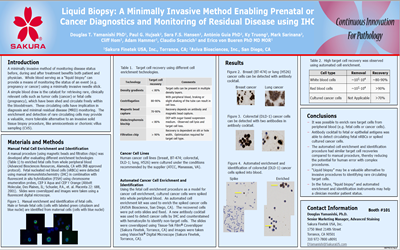
Liquid Biopsy: A Minimally Invasive Method Enabling Prenatal or Cancer Diagnostics and Monitoring of Residual Disease using IHC
A minimally invasive method of monitoring disease status before, during and after treatment benefits both patient and physician. Whole blood serving as a “liquid biopsy” can provide a means of monitoring the status of an event (e.g. pr
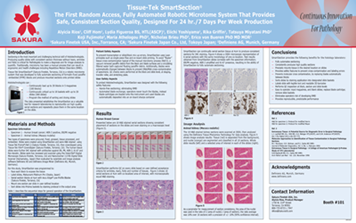
Tissue-Tek SmartSection® The First Random Access, Fully Automated Robotic Microtome System That Provides Safe, Consistent Section Quality, Designed For 24 hr./7 Days Per Week Production
Sectioning is the most important and challenging technical skill of Histotechnologists. Producing quality slides with consistent section thickness without tears, wrinkles and folds is critical for Pathologists to make a diagnosis and for image ana
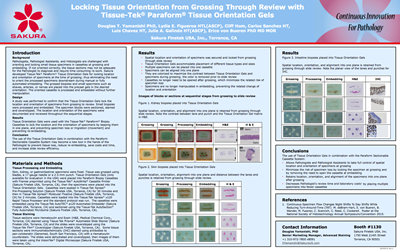
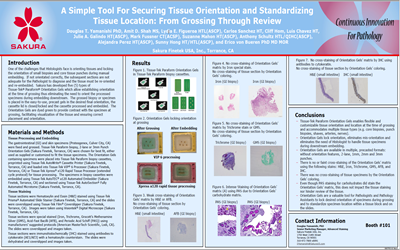
A Simple Tool For Securing Tissue Orientation and Standardizing Tissue Location: From Grossing Through Review
One of the challenges that Histologists face is orienting tissues and locking the orientation of small biopsies and core tissue punches during manual embedding. If not orientated correctly, the subsequent sections are not adequate for the Patholog
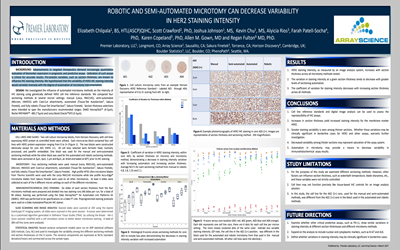
Robotic and Semi‐automated Microtomy can Decrease Variability in Her2 Staining Intensity
Advancements in targeted therapeutics demand increasingly quantitative evaluation of biomarker expression in prognostic and predictive assays. Calibration of such assays is critical for accurate results. Pre‐analytic variables, such as section thi
Locking Tissue Orientation from Grossing Through Review with Tissue-Tek® Paraform® Tissue Orientation Gels
Pathologists, Pathologist Assistants, and Histologists are challenged with orienting and locking small tissue specimens in cassettes at grossing and embedding. If not oriented correctly, the tissue sections may not be adequate for the Pathologist